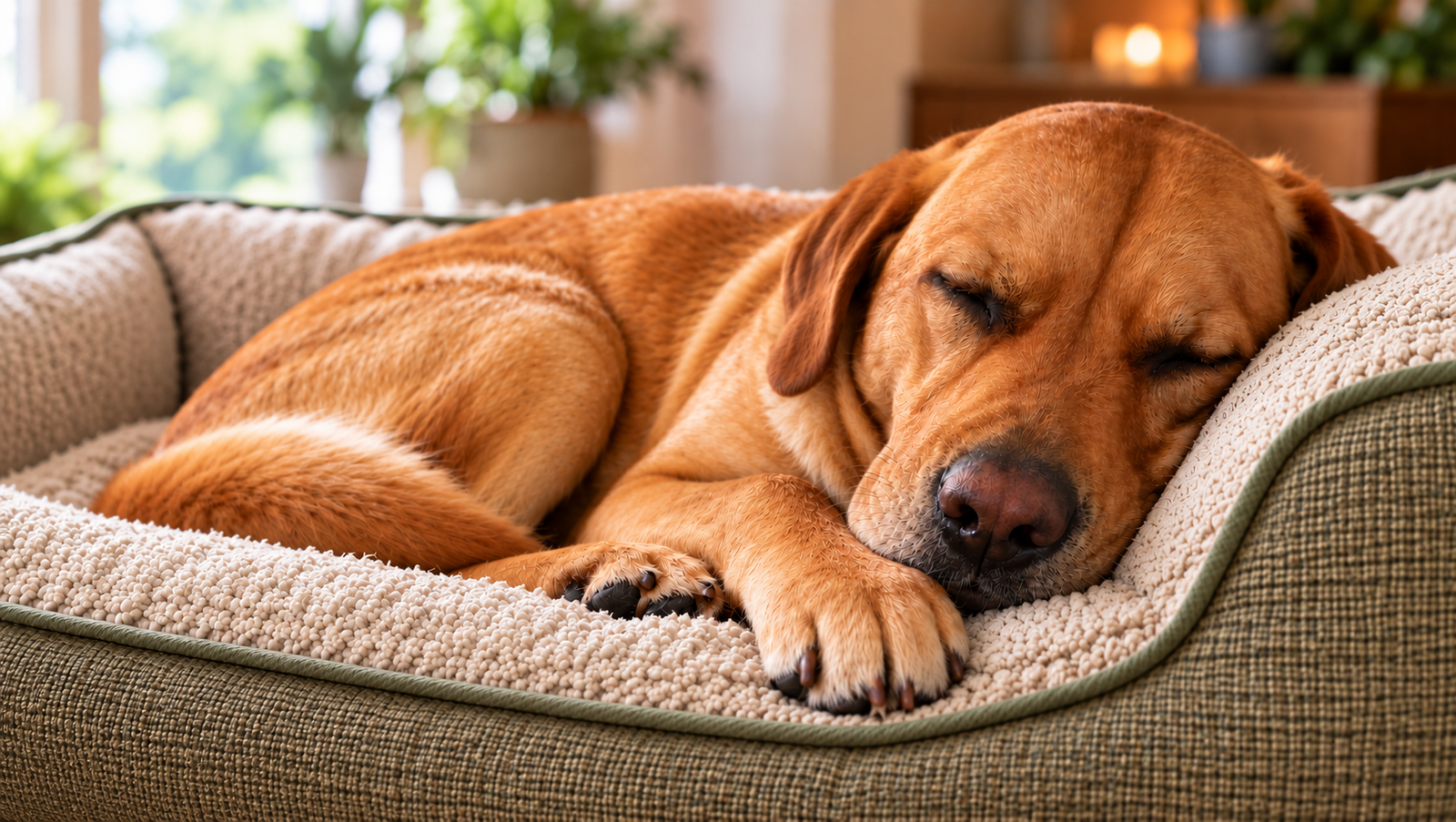
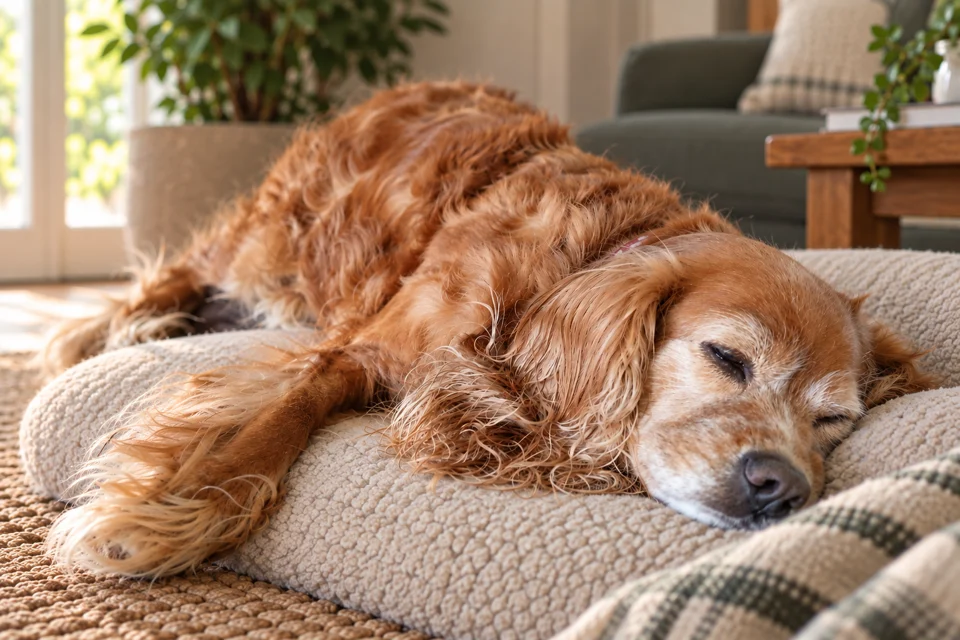
"Large" and "extra large" on a dog bed listing can mean quite different things between retailers. One retailer's "Large" can be another's "Medium," and the dimensions behind those labels vary. Breed and weight can be useful starting points, but they don't tell you how much space your particular dog actually takes up when they sleep.
The more useful approach is to measure your dog directly.
How to measure your dog
There isn't an official standard for measuring a dog for a bed, and manufacturers don't all give the same instructions — some measure nose-to-tail while standing, others measure a sleeping position. The most useful starting point is your own dog, in the position they actually rest in:
1. Wait until your dog is comfortably stretched out in one of their normal sleeping positions. Don't try to arrange them yourself — measure how they actually lie.
2. Measure the space they occupy. From the furthest point at the front to the furthest point at the back, then across their widest point in that position.
3. Allow some additional room. This gives your dog space to reposition, turn, or stretch further without immediately reaching the edge.
4. Consider whether your dog switches sleeping styles. A dog who sometimes sprawls and sometimes curls should be sized for their larger, stretched-out position — not their most compact one.
Check the sleeping area, not just the overall dimensions
Here's something worth knowing before you compare bed sizes: a bed measuring 120cm across isn't necessarily giving your dog 120cm of usable space. Raised sides and thick bolsters can take a substantial amount out of the internal sleeping area. When comparing beds, look for the internal or usable sleeping dimensions, not just the overall footprint. If a retailer only lists external measurements, it's worth asking directly for the dimensions inside the bolsters. Thick bolsters can reduce the usable sleeping area considerably.
Why space can matter even more for older or less mobile dogs
For an older or less mobile dog, having enough room to change position comfortably can be particularly important. If you're investing in a supportive bed, the supportive surface needs to accommodate the dog's normal resting position — good construction can only support the parts of the dog that are actually resting on it, so a bed that's too small leaves hips or shoulders unsupported regardless of the foam underneath.
If you're comparing beds on construction and support as well as size, we've covered what's actually worth checking in a bed's build here: What Makes an Orthopaedic Dog Bed Actually Supportive?
A quick sanity check
Rather than worrying whether every paw or their head stays on the bed — plenty of dogs happily sleep with a head or paw hanging over an edge by choice — the more useful question is: can your dog lie in their normal stretched-out position with their body, particularly their shoulders, spine and hips, supported by the sleeping surface, with enough room left to reposition?
Compare beds for your dog's sleeping space
Our collection is now available to shop. Check each bed's dimensions and, where supplied, its internal sleeping area against your dog's measurements.
Explore the dog-bed collection →
For the measurement steps at any size, read our dog-bed sizing guide.